Please note: This is general information, not legal or insurance advice. Your own policy decides what's covered, so check the details with your insurer.
If you’ve just had a crash, start with our guide on what to do after a car accident in Edmonton.
Does Insurance Cover Towing After an Accident That Wasn't Your Fault?
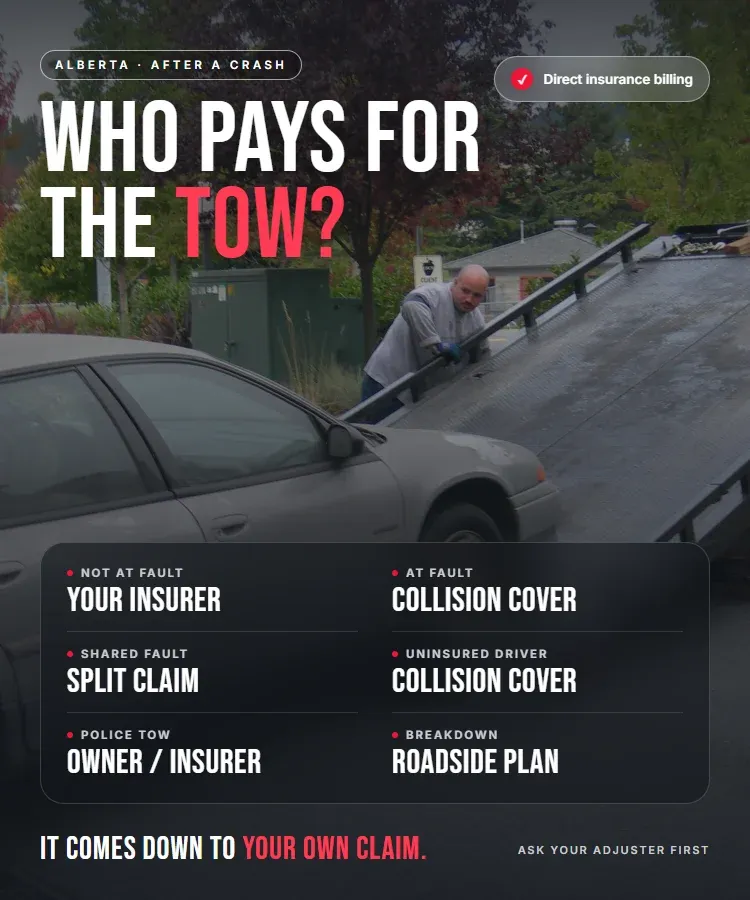
Usually, yes. Since January 1, 2022, Alberta has used DCPD. In plain words, you claim the damage to your car from your own insurer, not from the other driver's company, as the Government of Alberta explains.
This works even if you don't carry collision coverage. Say someone rear-ends you while you're stopped at a red light. You'd call your own insurer, open the claim, and the tow is normally handled as part of it. Ask your insurer to confirm before the tow is billed.
The province also tells drivers to contact their insurer when a car can't be driven, "so that suitable arrangements can be made." Make that call early. It saves a lot of back-and-forth later.
If the Accident Was Your Fault
Your collision coverage pays to fix your car after an accident, and the tow usually goes on the same claim. Your deductible still applies, so if it's $500, that first $500 of the claim is on you.
Check your policy documents or call your broker so you know where you stand.
What If Fault Is Shared?
Fault isn't always all-or-nothing. Alberta's fault rules can split it, for example, 50/50 or 75/25.
When that happens, your claim is split too. DCPD pays for the share that wasn't your fault, and your collision coverage, if you have it, picks up the rest. Your deductible may be adjusted to match your share of fault, so ask your adjuster how it applies to you.
Who Pays for Towing and Storage After an Accident?
Storage is the cost people forget. It's usually charged by the day, and a car that sits for two weeks waiting on paperwork can run up a real bill.
Alberta's standard auto policy asks you to protect your car from further loss after a crash. In practice, that means keeping it from sitting in storage longer than necessary. Here's what helps:
- Tell your insurer where the car is on your first call.
- Once the claim is open, move the car to the body shop rather than leave it in storage.
- Keep every storage invoice with your claim papers.
Since April 1, 2026, a tow company must give you a clear written estimate of towing and storage costs before the tow.
Roadside Assistance vs Insurance Towing
A tow after a breakdown isn't an accident claim. A roadside plan helps when your car battery dies, or your engine stops working, or under an optional add-on called the Emergency Service Expense Endorsement (SEF 35).
So, does car insurance cover towing when there's no crash? Only if you've added SEF 35 or a similar option. The SEF 35 form pays you back for towing and emergency service when your car is disabled, up to the limit in your policy. You'll need receipts, and it doesn't cover parts, gas, oil, batteries or tires.
For a boost, a lockout or a flat, see our roadside assistance in Edmonton.
How Direct Insurance Billing Works
Maverick Towing & Recovery offers direct insurance billing for accident tows on eligible accident towing and recovery claims. It's subject to your policy coverage and insurer approval. Here's how it works:
- You share your insurer's name, your claim number if you have one, and your adjuster's contact details.
- We check the tow and the charges with your insurer.
- The invoice goes to your insurer instead of you.
- You may still owe your deductible, or anything your policy doesn't cover.
Direct billing is for accident tows. Breakdown and roadside calls are paid the usual way.
FAQs About Towing Costs After a Crash
Do I have to pay the tow truck upfront?
Not always. If the tow isn't billed straight to your insurer, you may need to pay first and claim the cost back. Keep the itemized invoice, because your adjuster will ask for it.
Does liability insurance cover towing?
Liability-only insurance covers damage or injuries you cause to others, but it does not cover damage to your own vehicle if you are at fault in an accident. If you weren't at fault, DCPD can still pay your vehicle claim. However, separate roadside assistance or towing coverage may provide additional protection.
Who pays for towing after an accident if the other driver isn't insured?
DCPD doesn't apply if the other vehicle had no insurance, or if their insurer hasn't signed on to DCPD. In that case, you may claim under your own collision coverage, or go after the other driver or their insurer directly. Your insurer can tell you which route fits.
Who pays for towing after an accident if police order the tow?
The vehicle owner is responsible for the tow and storage, though it may be covered as part of an insurance claim. For cars taken to the impound lot, the Edmonton Police Service says the costs are the owner's or their insurance provider's responsibility.
How long will insurance pay for storage?
It depends on your insurer and your claim. Each insurer decides based on your claim, so ask your adjuster on the first call how many days they'll cover.
Need an Accident Tow With Direct Billing?
Stuck after a crash and not sure how the tow gets paid? Call 825-888-5533. Maverick Towing & Recovery Ltd is locally owned and available 24/7. We'll explain the charges and billing before we book, and we can tow to a body shop, your home or a storage yard. Learn more about our Edmonton accident towing.